

AI & CONSTRUCTION
Why Construction Is Moving Beyond AI Chatbots to Specialised Digital Teammates
For years, the construction industry has been told that artificial intelligence would transform project delivery. Most of what we’ve seen so far has been useful—but limited. Chatbots answer questions. Copilots help draft emails. Search tools find information faster.
But construction isn’t built on answering questions. Construction is built on specialists.
Every successful project depends on people with defined responsibilities: project managers, quantity surveyors, procurement teams, finance leaders, equipment managers, superintendents, and commercial directors. Each person brings expertise to a specific part of the project lifecycle.
The next evolution of AI follows that same model.
Instead of relying on a single AI assistant to know everything, organisations are beginning to deploy specialised AI agents—digital workers designed to perform specific roles, analyse specific data, and provide expert recommendations within a defined area of responsibility.
Construction Doesn't Have One Expert. It Has Many.
Think about how a major contractor operates. When leadership wants to understand project health, they don’t call one person.
They speak to multiple specialists.
The commercial team reviews profitability.
Procurement reviews commitments.
Finance reviews WIP and revenue recognition.
Project controls review forecasts.
Subcontract management reviews outstanding obligations.
Each area contributes to the picture.
The challenge is that gathering those insights often requires hours—or days—of manually assembling information from ERP systems, spreadsheets, reports, and disconnected processes. By the time the answers arrive, the opportunity to act may already be gone.
What If Every Specialist Were Available Instantly?
This is where specialised AI agents become interesting for construction. Rather than replacing people, these agents act as additional domain experts that can continuously analyse project data and surface insights in seconds.
A commercial manager
“Which projects are showing signs of margin fade?”
A procurement lead
“Which cost codes have commitments exceeding budget?”
A finance leader
“Which projects are not ready for month-end close?”
Each question requires different expertise, different calculations, and different business logic.
That’s why a single generic AI assistant often falls short. Construction workflows demand specialists.
Every AI agent specialises. Every AI agent collaborates. Together, they become an AI Workforce.
Introducing Construct 365 Copilot
At SIS, we believe the future of construction AI is not one large assistant trying to do everything. It’s an intelligent workforce of specialised digital teammates.
That vision led to the development of SIS Construct 365 Copilot—an AI operating layer for Project Cost Management that sits on top of Dynamics 365 Finance & Operations and Construct 365 Project Cost Management.
Instead of navigating reports, dashboards, and spreadsheets, users interact through a single natural-language experience. Behind the scenes, Construct 365 Copilot routes requests to specialised project-cost-management agents, each focused on a specific discipline.
Meet the Digital Project Team
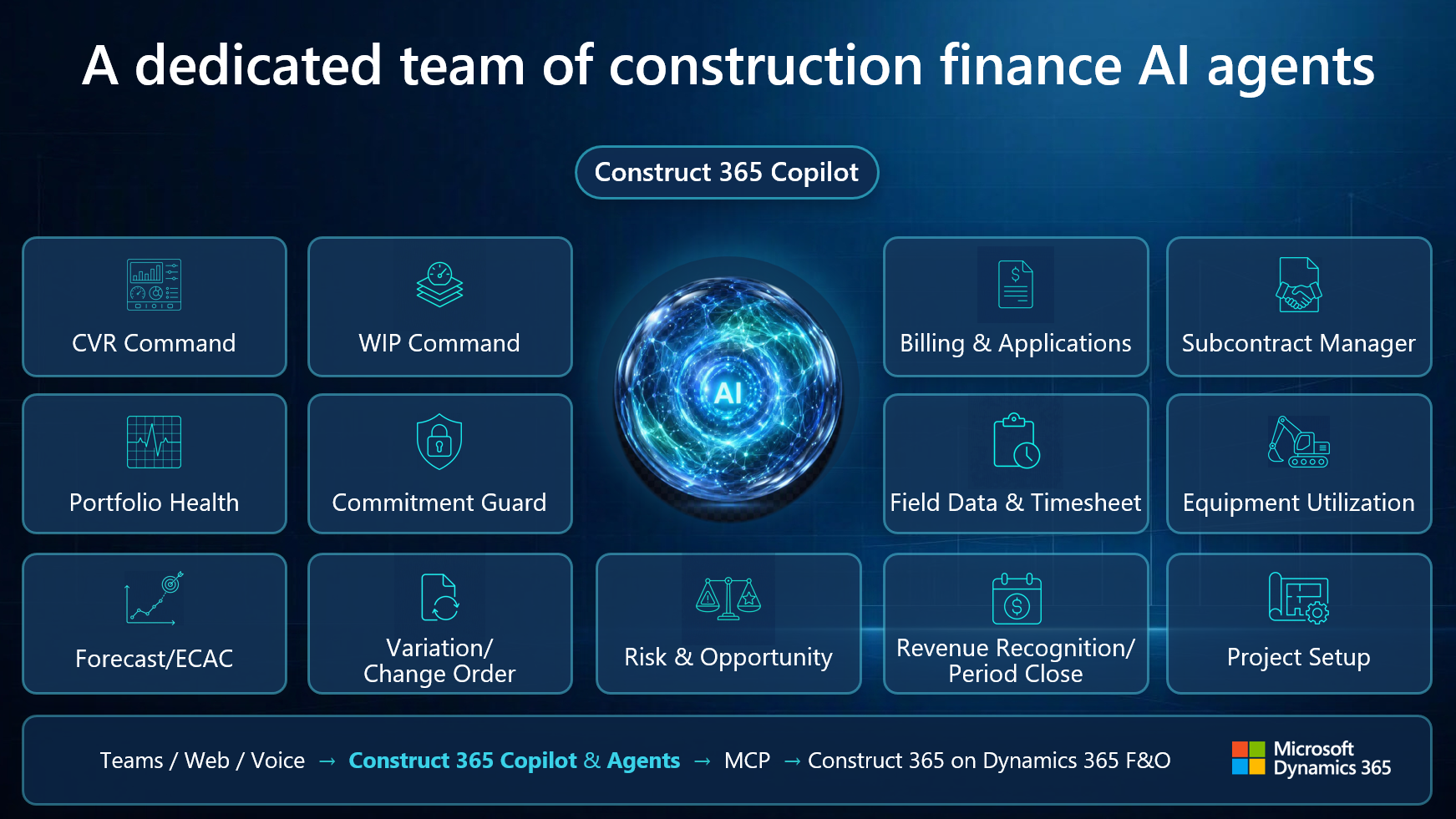
Much like a construction project relies on specialists, Construct 365 Copilot relies on specialised agents designed to support key commercial processes
CVR Command
Analyses Cost Value Reconciliation, including margin performance, ECAC, forecast variance, WIP, and over/under-billing positions
WIP Command
Role: Project Managers, Controller, Accounting, CFO, VP Operations
Provides work-in-progress analysis, including earned revenue, profitability, and margin movement.
Commitment Guard
Role: Project Manager, Procurement Manager, Director of Project Controls
Monitors committed costs against budget and identifies developing overruns before they hit actual costs.
Portfolio Health
Role: Operations Manager, CFO, COO
Looks across an entire portfolio of work to identify projects requiring management attention.
Billing & Applications
Role: Construction Project Accountant, Controller
Helps identify billing opportunities, revenue leakage, and over- or under-billing positions.
Forecast & ECAC
Role: Project Manager
Tracks future project outcomes and highlights early warning signs of margin erosion.
Period Close Command
Role: Construction Project Accountant, Controller
Supports close readiness by identifying outstanding activities and financial controls before month-end.
Additional Agents
Additional agents support subcontract management, field operations, equipment performance, risk management, change management, and project setup.
From Information Overload to Financial Intelligence
Construction organisations don’t suffer from a lack of data. They suffer from an inability to turn data into timely action.
The financial signals that matter most—margin fade, commitment exposure, forecast movement, billing leakage, cost overruns, and project risk—already exist inside the ERP system. The problem is that they’re often buried beneath reports, spreadsheets, and manual processes.
AI agents change that equation. Instead of asking teams to spend hours assembling information, the system continuously analyses the data and delivers answers in plain language.
The result is faster decisions, earlier intervention, and greater confidence in project outcomes.
The Future Isn't One AI. It's a Workforce.
Every generation of construction has added new tools. Mechanical equipment replaced manual labour. ERP systems replaced paper. Cloud technology connected the jobsite to the office.
AI is the next evolution. Not because it replaces people. But because it gives every project team a workforce of intelligent specialists that never stop learning, never stop analysing, and are always ready to help.
The future of construction isn’t one AI. It’s a workforce. And that workforce has already arrived.
Author: Rick Crowley, Global Solution Engineering Director, SIS

