

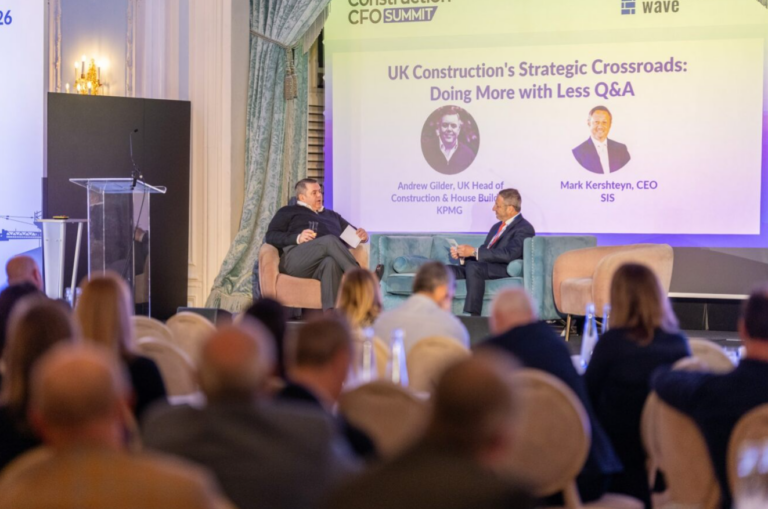
For those of you that couldn’t join us at the Construction CFO Summit at the Savoy Hotel in London on 13th May, here’s a summary of the keynote session presented by Andrew Gilder, UK Head of Built Environment for KPMG and Mark Kershteyn, CEO & Founder at SIS.
Summary: UK Construction’s Strategic Crossroads – Doing More With Less
The UK construction sector is facing a moment of pressure that feels fundamentally different from previous cycles. While the industry has always navigated tightening margins, rising costs, and economic uncertainty, today’s challenges are not new individually – but they are happening simultaneously. Margins remain thin, productivity has not improved meaningfully in years, talent is stretched, supply chains remain unpredictable, and insolvency risk continues to sit just beneath the surface.
This convergence of pressures raises a critical question for leaders:
Is this another cycle to manage through, or a structural turning point that requires a different approach to performance?
We believe the sector has reached a strategic crossroads. Traditional responses such as tightening control, pushing harder and refining reporting, are no longer enough. The industry must rethink how performance is created, how risk is managed, and how value is delivered.
- The Visibility Challenge: Issues Are Seen Too Late
There is a persistent visibility gap between what happens on site and what reaches the boardroom. Construction outcomes are shaped in real time, through thousands of small decisions made under pressure, often on-site. Yet in many organisations, Finance only becomes aware of issues once they appear in the numbers – by which point they are already embedded and difficult to correct.
Despite significant investment in systems, dashboards and reporting tools, the industry still struggles with early visibility. The distinction is crucial:
- Seeing clearly helps with understanding.
- Seeing early enough enables intervention.
In construction, that timing difference is often the difference between protecting margin and losing it.
- Where Value Is Really Created
Will improving reporting or financial processes alone, materially improve business performance?
While important, these activities do not move the core of the business. Real value is created in four operational areas:
- Cost control
- Delivery execution
- Cash conversion
- Real‑time risk management
When these slip, no amount of reporting can recover the lost margin.
Which would have a bigger impact on year‑end results – a 20% improvement in reporting efficiency or a 1% improvement in cost control?
The answer is obvious, and it highlights the need to focus on operational levers, not just financial ones.
- Internal Misalignment: The Hidden Barrier to Transformation
Transformation in construction rarely fails because of external factors. It fails internally, often due to misalignment between functions:
- Commercial teams focus on protecting margin.
- Delivery teams focus on protecting programme.
- Finance teams focus on protecting control.
Each priority is rational on its own, but collectively they create friction, delay decision‑making and dilute accountability. Without alignment around shared outcomes, even well‑designed transformation programmes struggle to take hold.
- The Risk of Over‑Transformation
Another challenge is the pace and scale of change. Many organisations attempt to transform too much, too quickly. Complexity grows faster than the business can absorb it, and because construction cannot pause delivery, disruption shows up immediately in project performance, cash flow and risk exposure.
The message is clear:
Transformation must be sequenced, disciplined and grounded in operational reality.
- Data and AI: The Opportunity and the Behaviour Gap
While data and AI are widely recognised as essential to the future of construction, few organisations have fundamentally changed how they operate as a result. The keynote highlights a critical insight:
Data problems are rarely technology problems — they are behaviour and ownership problems.
If data is still being corrected after the fact, the issue is not the system. It is the lack of accountability for data quality at the point of entry. AI cannot compensate for inconsistent or late data. For AI to deliver real performance improvement, organisations must embed behavioural change, role clarity and ownership across commercial, delivery and finance teams.
- Lessons from the US Market
The keynote draws comparisons with parts of the US construction market, where the adoption of integrated systems and data‑driven operations is moving faster. The difference is not simply investment, it is application.
US firms are increasingly shifting from reactive management to anticipatory management, enabled by connected data and tighter integration between delivery and finance.
Delegates watched a short video with Jeremy Hafen, CEO of Clyde Companies, giving a summary of his experience of finance transformation at his $4 billion construction company:
Insights from SIS: Practical Lessons from the US
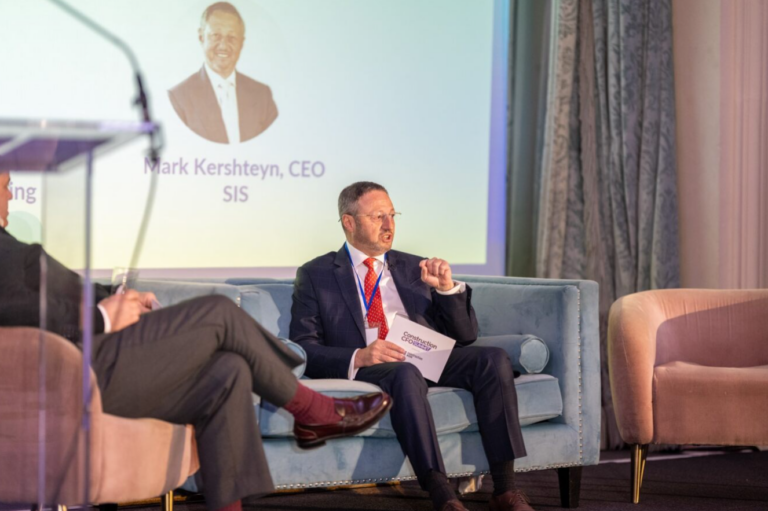
Mark Kershtyn joined the keynote to discuss how Microsoft Dynamics 365 and SIS’s industry‑specific solution, Construct 365, is helping construction businesses transform performance through integrated data, connected processes and real‑time visibility.
- Is this US Success Story a One‑Off?
Mark explained that SIS has been working with construction clients for over 30 years, and the challenges described in the keynote are universal. Construct 365 was developed specifically to address these issues by connecting Commercial, Projects and Finance within a single, out‑of‑the‑box solution built on Microsoft Dynamics 365.
Key points from Mark:
- Around 50 US customers are already using Construct 365.
- The 10 largest customers process approximately £15 billion of construction project revenue annually through the platform.
- The solution enables early identification of project issues, real‑time margin impact assessment and faster corrective action.
- Demand is growing rapidly in the UK and Europe.
- Challenges of Bringing Construct 365 to the UK
Mark noted that the core challenges in the UK and US are fundamentally the same: subcontractor management, change control, cost overruns and margin erosion. The main differences relate to market size and tax structures, not operational needs.
However, he highlighted several UK‑specific barriers:
- The UK industry is cautious due to past transformation failures.
- CFOs are wary of high‑risk, high‑cost ERP projects.
- Many businesses have accumulated technical debt and fragmented architectures.
Customers want straightforward, industry‑specific technology that can be implemented faster, with less risk and minimal customisation. They also want strategic partnerships with vendors committed to innovation, particularly in AI. Microsoft’s R&D investment, which exceeds that of Oracle and SAP combined, is a key differentiator.
- Mark’s Top Tips for Construction Leaders
Mark closed with three practical recommendations:
i). Prioritise Collaboration Across Functions
Transformation must bring together Commercial, Project Delivery and Finance into a single, data‑driven operating model.
ii). Invest in Change Management
The shift to modern, AI‑enabled platforms will require significant behavioural and cultural change across the organisation.
iii). Build a Scalable, Future‑Ready Architecture
Technology decisions must support both today’s needs and the rapid pace of innovation expected over the next decade.
Conclusion: A Sector at a Crossroads
The keynote concludes by emphasising that the UK construction industry is at a strategic crossroads. The pressures are not new, but the old responses are no longer sufficient. Doing more with less is not about working harder, it is about working differently.
Success will depend on:
- Seeing issues earlier
- Focusing on the levers that truly drive value
- Aligning functions around shared outcomes
- Sequencing transformation with discipline
- Embedding ownership of data
- Investing in scalable, future‑proof technology
If the sector gets this right, it will not simply manage through the pressure, it will redefine what performance looks like.
